
Important Dates
Submit a Proposal
Proposal coach request deadline: 9:00 a.m. ET on Monday, May 4, 2026 (submit draft in proposal database, then email CCCCevents@ncte.org with request)
Volunteer to review proposals or to be a proposal coach: May 11, 2026
Proposal submission deadline: 9:00 a.m. ET on Wednesday, May 27, 2026
Proposal notifications: Early September 2026
Session schedule notifications: October 2026
Convention dates: April 14–17, 2027, Milwaukee, Wisconsin
Questions and requests for coaches can be sent to CCCCevents@ncte.org.
Design Writing Futures
2027 CCCC Program Chair: Donnie Johnson Sackey, The University of Texas at Austin
Submit a Proposal
The late 1960s are often credited with the institutionalization of futures studies within the academy. As a practice, it has been a means of cultivating foresight—helping individuals, communities, and institutions understand how our choices shape what kinds of individual and collective futures become possible or preferable. The Futures Cone emerged within this line of inquiry to visualize multiple potential futures radiating outward from the present. While its conceptual roots trace to Norman Henchey’s (1978) taxonomy of possible, plausible, and probable futures, which was later developed by Charles Taylor (1990) and Trevor Hancock and Clement Bezold (1994) through models illustrating ranges of plausibility and preference, it was Joseph Voros who refined and popularized the Futures Cone by expanding its categories to include projected, preposterous, and preferable futures (Figure 1). Today, the Futures Cone serves as a foundational heuristic in speculative design, emphasizing that the future is not singular but plural, uncertain, and shaped by human values and imagination—perhaps a just use of imagination (Jones and Williams, 2020).
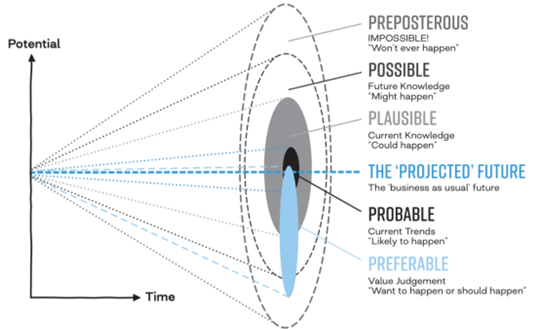
Figure 1. Joseph Voros’s refinement of the Futures Cone, which expands possible futures to include projected, preposterous, and preferable trajectories.
During times of despair—when political, social, or ecological collapse narrows our sense of possibility—the Futures Cone serves as a speculative design heuristic that reopens imaginative space. By visualizing multiple possible, plausible, and preferable futures, it resists the fatalism that often accompanies authoritarianism, racial retrenchment, or systemic oppression. Rather than predicting outcomes, the cone invites rhetorical and design practices oriented toward agency, multiplicity, and care, reminding us that the future is neither predetermined nor predictable. In this way, the Futures Cone becomes a tool for reclaiming futurity itself—for envisioning justice-oriented worlds even amid crisis.
Designing, Writing, and Futuring in Milwaukee
The theme “Design Writing Futures” offers a disciplinary opportunity to reclaim or lean into imagination. As Silvio Lorusso (2023) articulated, design does not emerge from a blank slate; it emerges from wicked problems, chaos, contingency, and instability (What Design Can’t Do: Essays on Design and Disillusion). The act of designing draws a boundary—a magic circle—that temporarily orders one piece of reality while excluding the overwhelming, uncontainable rest. That boundary is always porous; entropy inevitably intrudes. “Design Writing Futures” invites us to consider not only what design can do, but what it cannot contain.
Design is left with only one option: staring chaos in the eyes, waiving the somewhat reassuring notion of “complexity.” For chaos is not complexity: complexity is a field where various forms of expertise compete; chaos is the repressed that returns when the experts fail. If as James Bridle argues, “complexity is not a condition to be tamed, but a lesson to be learned,” chaos is a grievance that has nothing to teach. (Lorusso, 2023, pp. 17–18)
Chaos, in Lorusso’s framing, is what erupts when our systems—technical, social, political—collapse under their own limitations. Complexity invites learning. It challenges assumptions and requires humility. It forces us to consider systems, entanglements, and interdependencies. As teachers, scholars, and researchers in writing studies, we know a thing or two about designing amid complexity despite the ways our institutions often frame the future in simplistic, narrow, predetermined ways: through enrollment algorithms, budgetary projections, technocratic reforms, or reductive narratives about the value of the humanities. As writing teachers, scholars, and researchers, we work at the intersections of constraints and possibilities. We—especially those of us at two-year colleges and in teaching-intensive roles—navigate material precarity, limited autonomy, and shifting mandates. Our work inherently involves imagining student futures—academic, civic, professional, and communal. Foresight and futures-thinking methods—frequently drawing on the Futures Cone—have been adopted in community and development work (e.g., by the United Nations Development Programme, community-development coalitions, and social-movement organizers) as tools for participatory visioning, equitable planning, and resistance to linear, inevitability-driven narratives. More broadly, contemporary scholarship on foresight, environmental justice, and design as hope treats design/futures thinking/speculative methods as tools for reimagining seemingly doomed problems (e.g., climate crisis, systemic inequality) through hope-based, justice-centered design practices (Costanza-Chock, 2020; Design Justice Network, 2018; Kim et al., 2025; Smith-Foster & Castle, 2022; Thailand Institute of Justice, 2021).
I believe this wider landscape of justice-oriented foresight underscores why the Futures Cone is so valuable to our own field: It equips us with a framework for imagining futures not dictated by current political or institutional pressures. As a design heuristic, the Futures Cone reminds us that these trajectories are not inevitabilities. Instead, it prompts us to imagine and design writing futures that resist shrinkage, standardization, and fatalism by illuminating the full range of possible, plausible, probable, preferable, and even preposterous futures available to us. By visualizing multiple trajectories rather than a single path, the Futures Cone can help us identify the small, everyday decisions that can shift probable futures toward preferable ones, whether in assignment design, program advocacy, or broader commitments to justice and democratic engagement.
In this sense, “Design Writing Futures” is not simply a theme but a method for taking stock of our present conditions, for tracing the institutional forces that shape which futures become legible, and for foregrounding the local knowledges, rhetorical capacities, and design practices that our field already cultivates. In this moment of reflection and call to conference, I find it important to look to scholarship and research in writing studies that treat design thinking not as a tool for corporate innovation or product design, but as a rhetorical, pedagogical, and ethical methodology for institutional critique and change (see Purdy, 2014; Tham & Pellegrini, 2025; Thominet, 2022; Turner & Rose, 2025)—or as Richard Marback (2009) articulated, an embrace of wicked problems through “a process of responding to others” (p. 419). “Design Writing Futures” urges us to attend to the lived experiences of students and instructors whose futures are too often constrained by policy decisions outside their control; to examine how writing, rhetoric, and literacy operate as technologies for imagining otherwise; and to mobilize speculative, critical, and justice-oriented design practices as tools for rethinking what teaching, research, scholarship, and service in writing can and should become.
Ultimately, “Design Writing Futures” calls our community to use our disciplinary expertise—in rhetorical criticism, multimodal composing, community engagement, language justice, writing program administration, and design thinking—to craft futures that are more inclusive, more just, and more imaginative than the ones currently projected for us. In doing so, it invites us to refuse despair, to cultivate foresight, and to participate actively in shaping the worlds that writing makes possible.
Possible Futures: Opening Imagined Trajectories
- What new possibilities for writing, pedagogy, or community engagement emerge when we treat the future as plural rather than predetermined? For instance, how might approaches like multimodal composing, local archival projects (Project Mend, n.d.), or mutual aid-oriented literacies (Middleton, 2023), shift what we imagine writing can do—and for whom?
- How does the work you’re already doing gesture toward a writing future that our field has not yet fully recognized or valued? This might include emerging practices such as anti-carceral feedback models (Fernandes et al., 2023; Moro, 2020), community storytelling with climate-affected groups, culturally-sustaining assessment practices, accessibility-forward writing program design, data feminism, or design justice (Libertz, 2025).
- What imaginative, speculative, or emergent practices does your work invite us to consider as seeds for future disciplinary directions? For example, does your teaching experiment with infrastructural literacies (Edwards, 2021; Hutchinson & Novotny, 2018), restorative pedagogies (Pierce, 2025), counter-mapping (O’Brien, 2024), Indigenous speculative design (Ko et al., 2025), or other forms of rhetorical invention that help students imagine alternatives to dominant narratives? For example, how might Black speculative storytelling, which Tao Leigh Goffe (2022) argued is not escapism but a political method of “stealing away” colonial time to undo its logics (p. 110), reshape the speculative futures we imagine? How does your work draw on traditions in which the impossible becomes a strategy for survival, critique, and worldmaking?
- What might it mean to design for future scholars, researchers, and teachers? What might futures-oriented design resemble when grounded in responsibility rather than disruption? Consider Indigenous approaches to futures thinking (e.g., seven generations principle)—which critique dominant futurist narratives that prize speed, novelty, disruption, innovation, and individualism (Clarkson et al., 1992). How does your research and scholarship help our scholarly community and larger publics cultivate responsibility to and kinship with humans, nonhumans, and the planet?
Plausible Futures: Tracing Emerging Trends
- How might emerging technologies, pedagogies, sociopolitical dynamics, or cultural shifts plausibly shape writing and rhetoric in the next decade? For example, what might happen as AI-assisted composing becomes normalized (Duin & Pedersen, 2021; 2023), as students navigate new community literacies shaped by the expanding footprint of data centers (Edwards, 2025), or as campuses contend with racial retrenchment and anti-trans policies that directly affect whose literacies, identities, and futures are supported (Kynard, 2013; Maraj, 2020; Patterson, 2020)?
- How does your work map the potential consequences (intended or unintended) of these near-future trends for writers, students, teachers, or communities? This might involve anticipating how automated plagiarism detection reshapes trust, how multilingual AI tools shift language instruction (Ghimire, 2025; Gonzales, 2022; Lawrence, 2024), how datafication affects student privacy, or how political polarization impacts public-writing assignments and assessment (Giroux & Paul, 2024).
- What rhetorical, ethical, or design questions should the field grapple with as these trends develop? For instance: What counts as authorship in human-AI collaboration? How should writing programs respond to widening inequities in tech access or increased digital surveillance (Kelley, 2022)? How might community partners be impacted by shifts in digital infrastructure or civic communication tools?
Probable Futures: Making Visible What Might Otherwise Be Assumed
- What dominant trajectories or institutional forces are currently shaping the “probable” future of writing and rhetoric? For instance, how are shifts in student demographics, the platformization of learning, changing workplace literacy expectations (Hart-Davidson et al., 2024), climate-related disruptions, multilingual student populations, or the growing influence of design justice reshaping what writing instruction is likely to become?
- How must we interrogate and reimagine these trajectories? Does your work reveal tensions in these emerging paths, offer counter-narratives to enrollment-driven restructuring, challenge platform-dependent writing ecologies, rethink the labor conditions shaping writing programs, or highlight new forms of public, community, or digital writing that complicate current assumptions?
- Whose futures become probable under existing systems—and whose futures are obscured, constrained, or ignored? For example, which students, teachers, or communities are served by these probable trajectories, and which are sidelined? How do these systems differentially shape possibilities for multilingual writers, first-generation students, contingent faculty, or community partners whose literacies fall outside institutional norms (Scott et al., 2025)?
Preferable Futures: Envisioning Just, Inclusive, and Life-Affirming Cultures of Writing
- What practices, pedagogies, or policies might move us toward more humane, equitable futures for writing programs, classrooms, workplaces, and communities? How might we cultivate preferable futures by designing pedagogies that honor multilingual and transnational literacies as intellectual assets rather than deficits? What might it look like to build writing cultures that respond compassionately to shifting patterns of reading, attention, and cognitive load—creating slower, more accessible, or more multimodal environments that support diverse ways of engaging with texts (Arola, 2015)?
Preposterous Futures: Challenging the Limits of the Imaginable
- What speculative, “preposterous,” or radical futures might productively disrupt the field’s assumptions? What might happen if the semester collapses into micro-residencies where students cycle between community partners, workplaces, and local ecologies—turning rhetorical education into a rotating set of lived contexts rather than classroom assignments? Or what might happen if we work with students to design their own literacy technologies (interfaces, scripts, reading protocols, cognitive tools), making writing instruction a site of technological invention rather than technological adoption (Hart-Davidson, 2001)?
- How can counterfactuals, alternative histories, or impossible futures help us rethink what rhetoric and writing could become? What might emerge if we imagine futures where campuses abandon proprietary platforms, where public communication infrastructures are community-owned, or designed in response to climate-disrupted conditions (Hopkins, 2023)? How might alternative histories make strange our assumptions about what literacy or what our disciplinary trajectories “should” be (Jones et al., 2016; Piercy, 1997)?
- How might we harness imagination to resist fatalism, authoritarianism, or narrowing senses of possibility? For instance, how might imaginative writing practices—counter-mapping, speculative composing (Coleman, 2021; Sundvall, 2019), crip technoscience interventions (Rauchberg, 2022), multilingual storytelling (Krasova & Moroz, 2024), or attention-restoring pedagogies (Tench, 2022)—help us break from presumed limits—stay with the trouble—and cultivate expansive, justice-oriented futures for writers (Haraway, 2016)?
Special Cluster: Futures beyond Crisis
I invite proposals that take up the challenge of imagining, theorizing, and practicing futures that persist beyond crisis. This special cluster seeks work that confronts the pressures of despair while cultivating alternative trajectories—futures shaped by resilience, collective care, reparative imagination, and rhetorical possibility. Contributors are encouraged to explore how writing, teaching, research, and community engagement can open space for futures that are not foreclosed by collapse, but nurtured through persistence, maintenance, and hope. Consider:
- How are you responding to conditions in which political, social, environmental, or institutional despair narrows our sense of what futures are possible?
- How are you working to resist fatalism by expanding (rather than foreclosing) our imaginative and rhetorical capacities?
- What does it look like to design resilient, hopeful, or liberatory futures even in moments of collapse or uncertainty?
- In contexts where systems fail or infrastructures collapse, what forms of rhetorical or pedagogical persistence become necessary to rebuild collective futures (e.g., mutual aid literacies, community archiving, restorative communication)?
- What futures emerge when we center slow work, maintenance, and everyday persistence rather than “innovation” as the engine of disciplinary possibility?
Acknowledgements
I am incredibly grateful for the intellectual support of Timothy R. Amidon, Jim Ridolfo, Jennifer Sano-Franchini, Jennifer Stewart, and members of the CCCC Executive Committee for their generous feedback during the development of this CFP.
Important Dates
- Submit a Proposal
- Proposal coach request deadline: 9:00 a.m. ET on Monday, May 4, 2026 (submit draft in proposal database, then email CCCCevents@ncte.org with request)
- Volunteer to review proposals or to be a proposal coach: May 11, 2026
- Proposal submission deadline: 9:00 a.m. ET on Wednesday, May 27, 2026
- Proposal notifications: Early September 2026
- Session schedule notifications: October 2026
- Convention dates: April 14–17, 2027, Milwaukee, Wisconsin
Questions and requests for coaches can be sent to CCCCevents@ncte.org.